Pages

Saturday, September 19, 2009

Greetings Postcard from Bombay Presidency - WWI


Coming Monday happens to be holiday here in India to be celebrated as Ramzan, an important Muslim festival. Thus, I will try to post 3 articles if possible enjoying my holidays at home.

Today's article is about British Indian Army or more popularly known as Indian Expeditionary Force's participation in World War I in Mesopotamian and Persian campaign.

The Middle Eastern theatre of World War I was the scene of action between 2 November, 1914, and 29 October, 1918. This theatre encompassed the largest territory of all the theatres of the war. There were five main campaigns: the Sinai and Palestine Campaign, the Mesopotamian Campaign, the Caucasus Campaign, the Persian Campaign and the Gallipoli Campaign. Indian army participated in all of campaigns but today's focus is only two of them based on articles that I am going to produce here.

Mesopotamia Campaign

Shown below is a postcard printed and published by Times of India press, Bombay for the Women branch of the Bombay Presidency War & Relief Fund headed by Lady Willingdon. It was Xmas and New Year greetings card for troops. The postcard depicts British Indian Army soldier trying to host British Flag on left side while right side shows an ancient bridge destroyed by the Turks in Mesopotamia.
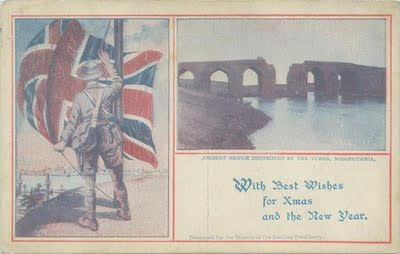
The largest Indian Army force to serve abroad was Indian Expeditionary Force D in Mesopotamia, under the command of Lieutenant-General Sir John Nixon. The first unit sent in November 1914, was the 6th (Poona) Division they were tasked with guarding British oil installations in and around Basra. Firstly under the command of Major General Barrett and then Major General Townshend, the Mesopotamian campaign after a string of early successes, was delivered a setback at the Battle of Ctesiphon in November 1915 due to Logistical constraints. Following this engagement, the Poona Division withdrew back to Kut, where Townshend made the decision to hold the city and the Siege of Kut began.

Between January and March 1916, both Townshend launched several attacks in an attempt to lift the siege. In sequence, the attacks took place at the Battle of Sheikh Sa'ad, the Battle of the Wadi, the Battle of Hanna, and the Battle of Dujaila Redoubt.

These series of attempts to break through the encirclement did not succeed and the cost was heavy with both sides suffering high casualties. In February food and hopes were running out for Townshend in Kut-al-Amara. Disease were spreading rapidly and could not be cured and Townshend surrendered in April 1916. In December 1916, the 3rd and 7th Divisions arrived from the Western Front.

In 1917, the British force, under Frederick Stanley Maude, which now included one cavalry and seven infantry divisions from the Indian Army, in the III Corps (India) advanced towards Bagdhad which was captured in March. The advance continued in 1918, and after the Battle of Sharqat in October the Turkish forces surrendered and the Armistice of Mudros was signed. The Mesopotamian campaign was largely an Indian Army campaign the only British formations involved were the 13th (Western) Division and British battalions assigned to Indian brigades. The casualties for the campaign were 11,012 killed, 3,985 died of wounds, 12,678 died of sickness, 13,492 missing and prisoners which includes the 9,000 prisoners from Kut and 51,836 wounded.

Persian Campaign

Shown below is another such postcard printed and published by Times of India press, Bombay for the Women branch of the Bombay Presidency War & Relief Fund headed by Lady Willingdon. It was again part of same series of Xmas and New Year greetings card for troops. The postcard depicts British Indian Army soldier trying to host British Flag on left side while right side shows troop movement on Persian frontier.

In 1914, Britain had British Indian Army units located in the southern influence zone of Persia. Indian Expeditionary Force F's 33rd Brigade participated in this Campaign. The 33rd Brigade was sent to Bushire in Persia in August 1915, and then disbanded in December 1915. The aim of brigade was to protect the Anglo–Persian oil installations in south Persia and the Persian Gulf. In 1916, the British formed the South Persian Rifles after disbanding Indian units to protect their interests in Persia.

Saturday, September 12, 2009

World War II - Pamphlets on India


Well, I learnt today couple of essential features of blogging :-) As a lazy blogger, I never checked advanced features offered by Google. I used to write my blog hard way ;) by making all changes myself as required in "Edit HTML" tab (yeah, I still have some element of programming left in me!!) I plan to explore more to make blog more user friendly and presentable slowly so you may observe some changes (including blackouts!!) over period of time.

I never asked for feedback from my readers (again because of my laziness) but I would like to know if you would like certain features to be enabled/disabled or want change in layout etc. Feel free to comment or drop me an email.

Now, lets return to original post. Today's item is about two pamphlets produced by the Directorate of Army Education, India meant for British soldiers arriving in India during war period.

The first pamphlet is on India itself titled "This India". There were some 15000 copies of this pamphlet printed in April, 1945.
The pamphlet talks about the first impression soldiers get when they land versus what they learn through movies and books. For most of them, it is disappointing end of an illusion that they had. Then in next couple of pages it goes on explaining what is India all about - starting from its thousands year old civilization (giving a short lecture on history) to its current state.

Of course the pamphlet is kind of propaganda showing East India Company and British Crown in positive manner and what all they have done for Indian subcontinent dismissing all allegations of wrong doing or not doing enough to improve the living standard of Indians despite exploiting them for hundred of years.

And the uniqueness about this pamphlet is that it is not brain cleansing program for Indians but for British soldiers so that they don't get discouraged observing current situation of India and return to England at this need of hour.

For benefit of readers, I have scanned the pamphlet completely so one can read it here on my picasa link This India. It's a small but very interesting pamphlet.

Once the pamphlets succeeds brain washing soldiers then comes the next step of introducing them to Indian soldiers. Here the second pamphlet comes into picture. This pamphlet is also produced by the Directorate of Army Education, India titled "The Indian Army". Similar copies of this pamphlet were printed in same time.
This pamphlet introduces British soldiers to Indian army and its various regiments. The pamphlet describes the valor and bravery of Indian soldiers in current and previous war. This one is rather fact than any propaganda. It encourages soldiers to get accoustomed to Indian traditions and befriend their Indian counterparts. That's the key to success in this war as both British and Indian soldiers have to fight together in all fronts.

This is another interesting read and for those of you who would like to read it completely, here's link The Indian Army.

Finally, the pamphlets shown here are reprinted version from original pamphlets but these are original reprints during war days not the usual modern reprint. It's just like the way "Indian Information" - periodical of British India goverment were reprinted in US during war timer to save the paper and transportation cost.

Sunday, September 6, 2009

British India Propaganda Leaflet Aganist Japan


Yesterday, I bid on Ebay for two of Japanese leaflets against British India. I missed one of them in last seconds as usual (didn't learn from my past mistakes!). Both of them were really eye catching as I hadn't seen them earlier. It was long time since I saw some India related propaganda leaflet on eBay for sale. Usually, such leaflets are sold only in specialized auctions.

The loss of one such leaflet and win for other prompted me to show some leaflet on my blog :-) Not only that it has been long time since I showed one but I also noticed that 1 out of every 10 visitor at my blog looks leaflet posts :D (encouraging for me to burn my hard earned money on these!!) As one of my friend said, "I would become Jyotirmay Kachrawala/Raddiwala (one who is trader of old/waste paper) soon if I continue doing like this."

Anyway, let's start. Today's leaflet was issued by British India targeting soldiers of Indian National Army who were fighting against Allied forces in South East Asia front with Japanese assistance. It's coded 2MPS/H2. As per Herbert Friedman's article, 2MPS/H stands for 2nd Mobile Printing Shop written in Hindustani. These were very short series and produced right at the end of war. Only seven leaflets are known to have been disseminated.

The translated version of above leaflet is as follows:

Soldiers of Indian Army

You are very much aware how Japanese treat you. You had to walk all the way from Malaya while Japanese used railways and motors for their transportation. This is how they treat you. And when you reach here then you are denied rest instead ordered to fight in front line.

You have been in such a bad situation for last three years roaming outside India. We were aware of the fact that you were in such a pathetic condition. If you cross over (switch) to our side then you can meet your old friends and return safely to India in couple of days.

Decide quickly and act immediately! If you don't act now then as Japanese retreat they will force you also to retreat and do humiliating work/action. If you remember when you were taken as prisoner of war first time then you were forced to stay hungry and do humiliating work. These are same Japanese.

This is an opportunity for you; don't let it go waste - switch side now. This is right opportunity for you to take revenge from your real enemies. Stop befriending them, put their ammunition on fire, destroy their weapons and join us. We promise you that you will return to India in couple of days.

Reverse side of the leaflet has text written in Urdu language carrying same propaganda.

Sunday, August 30, 2009

Jodhpur Government Gazette - July 14, 1945


Today's post will be another short one. As I scan most of literature stuff that I bought over couple of months I am sharing it here. With this post another thread starts - Princely States Gazettes covering war related news or articles.

Under British arrangement, most of princely states were granted permission to maintain law and order and run general affairs of their area on their own. As part of that most of princely states used to publish what is called state gazettes for general public consumption. It was kind of information sharing by the government to the people. The gazette not only served the purpose of publishing government policies, announcements and news but it also gave them control to restrict/censor the information to be distributed especially during war period. Even though , Radio/newspaper were available but very few people in India in those days could afford it. The gazettes also served as state propaganda at times encouraging people to donate to war funds, providing both true and fabricated news of Allies win and publishing advertisements to join allied forces.

Shown above is a page from Jodhpur Government Gazette published on July 14, 1945. Since, it is already in English I thought I won't need to explain it but later I realized that it would be almost impossible to read it because of spacing problem in blog. So here it is:

British "Recce" Party in Germany

"The gazette shows a picture taken by a British Army photographer who accompanied a British patrol on a reconnaissance in Germany, shows members of the patrol approaching their objective. British troops on this front and in the Ardennes were issued with white camouflage cloaks. Guns, rifles and radios are all wrapped in white, with the good effort seen."

The uniqueness of this gazette is that it carries a photograph cyclostyled. Very few gazettes carried photographs as most of these gazettes were typed.

Even though the description on gazette doesn't mention explicitly but the troops here are of Indian origin or part of Indian regiments. There are couple of reasons to believe that. I have another such document where similar photographs are shown addressing them as Indian soldiers besides the photograph and statement is conveying the message that British Government has taken all precautions to ensure safety of soldiers by providing white camouflage, allaying concerns of families of soldiers and encouraging public to join forces.

Saturday, August 29, 2009

Red Cross Booklets - WWII


Today's post will be relatively smaller than earlier ones. Over the last couple of months I have amassed so many books/booklets and literature item that now I concentrate more on literature items than postal items which used to be my first passion :-)

I will try to show more of these over period of time along with postal items striking proper balance between them for all of my readers.

First item is "A Guide Book to Calcutta, Agra, Delhi, Karachi, and Bombay". The booklet was published by The American Red Cross of the China-Burma-India (CBI) command. It was printed at Modern Art Press, Calcutta. This booklet seems to be printed somewhere around 1942.

The booklet describes about Red Cross in brief and then addresses the audience of this booklet i.e. the American servicemen and women who will be stationed in India as part of strengthening CBI (China-Burma-India) and SEAC (South East Asia Command) front.

WHAT IS THE RED CROSS ?

The American Red Cross - chartered by Congress to give aid in time of peace and war - is the agent of the American people, who support it by voluntary contributions. Its services are world-wide.

Field directors and hospital workers are aided by volunteers in more than 3700 chapters and 6000 branches serving every county in the country. The Red Cross gives services too numerous to mention here - such as helping in disaster, promoting health and safety, collecting blood-plasma, and so on. But remember this: that a prime duty of the Red Cross is to aid service and ex-service men and their families - with everything from advice to a financial lift in emergency.

In 1942 field directors aided 864,000 active service men and gave loans and grants amounting to $4,500,000; local chapters aided families of 800,000 service and ex-service men; and hospital workers served 264,000 convalescents in Army and Navy hospitals.

You can read most of its content at CBI Theater website.

Another book is "The American Red Cross With The Armed Forces". The book was published in May, 1945 almost near end of war and printed at Allied Printing, Washington D.C. Although, this booklet is not related to India in any manner still I have shown it here as it applies in general to Red Cross activities wherever American servicemen and women served including India.

The booklet describes red cross charter and area of work in more detail like the services provided to the soldiers, welfare programs run, services to the sick and wounded, recreation for troops overseas, services to the soldier and his family, services to the veteran and his family and finally services to prisoners of war.

The booklet was published to answer personal questions of the American families and neighbors of some 11300000 servicemen and women in the Army, Navy, Marine Corps , and Coast Guard: What is the American Red Cross doing for the serviceman himself? What are its representatives doing for him when he is homesick and worried, bored, restless, sick or wounded? What are they doing for him in the field, the leave area, the hospital? What are they doing when he returns home, discharged, and has problems resulting from his service? The trained men and women who are, we are told, "at his side" -who are they, what facilities do they have to work with, and exactly how do they work? Finally, how do the Red Cross chapters here at home help him and his family?

Sunday, August 23, 2009

Palitana Cash Coupon - WWII


With today's post I am starting a new thread on paper money/currency notes/cash coupon used in India during WWII. This is one of the interesting area of Indian paper money history besides being one of the popular theme among numismatics.

Before I show off some of my stuff which will be focusing on only one of such issues, let's have another round of history tour :D on cash coupons of princely states of India. Their place in the history of Indian Paper Money is in the realm of exigent money (Emergency issues).

During the World War II a great scarcity of precious metals led to a shortfall in the circulating sphere. The Mints were no exception and their capacity was increasingly used to mint coins for "Imperial Purposes". By 1942, an acute scarcity of small coins was felt throughout India. While British India managed with postal surrogates, petty princely states in Western India like Balban, Bikaner, Bundi, Gondal, Indergadh, Junagadh, Jasdan, Kutch Mengni, Muli, Morvi, Mangrol, Nawanagar, Nawalgarh Palitana, Rajkot, Sailana, Sayla, Vithalgadh, issued what are alluded as Cash Coupons to meet the shortage. Some of these states were of an insignificant size, less than 100 sq. miles in area.

Though, some states sought the prior permission of the Government of India to issue Cash Coupons, the persistent negation of the authorities led many others to issue the coupons unofficially and satiate their needs. Most of them are therefore of very low denominations.

The Cash Coupons can be grouped into certain aggregates depending on their nature, issuing authority, mode of payment, etc. Most Cash Coupons were printed crudely on press board.

Group 1 - issued with simply the impressions of the fiscal or revenue stamps on a cardboard and serially.
Group 2 - issued through the State's treasury and bear the signature of the treasurer or accountant.
Group 3 - issued through certain local banks which had royal patronage.
Group 4 - do not fall in any of these categories and were issued simply as tickets with or without an authorising signature.

The Cash Coupons, by their nature, enjoyed a limited circulation. There were restrictions on their encashment. Soiled, torn or stained coupons were not encashed. While encashing, many states imposed a condition that only such quantity of coupons could be encashed which would be equivalent in value at least to a full Rupee. Overall, coupons were in circulation until 1946.

Today's blog focus on cash coupons issued by Palitana state which falls under third group mentioned above.

Palitana was a native state of India in the Kathiawar agency of the Bombay presidency which was later merged into Saurashtra and is now part of Gujarat state of Modern India. It was ruled by a Thakore sahib (also spelled Thakor Saheb), enjoying a 9-guns salute, accessed to independent India on 15 February 1948.

There were two type of coupons issued by Palitana: large ones by Palitana Darbar Bank valid until 31-10-1943 and signed by the Bank manager and smaller ones like revenue stamps carrying portrait of Thakor Shri Bahadursinghji (ruled 1905-1919 as minor & 1919-1948 as ruler) [as shown above on front side] printed at "B. P. Press" [carrying the name on reverse with serial numbers as shown below]; valid until 1945.

Legend above portrait on front side reads 'General Stamp' only along with denomination on top while Palitana State at bottom. The language used on front and reverse side of these Cash Coupons is Gujarati.

The above 4 such Cash Coupons in my collection are recorded in "The Standard Reference Guide to Indian Paper Money Catalogue" by Kishore Jhunjhunwalla which is the best catalogue in this area. The above are in denomination of 4 Annas, 2 Paisa, 2Annas, and 1 Anna.

Unfortunately, I don't have larger ones in my collection. Once I get my hands on it, I will share it here.

This post can't end without mentioning the fact that Palitana is world famous for its marble temples. The Palitana temples are considered the most sacred pilgrimage place by the Jain community. There are more than 1300 temples located on the Shatrunjaya hills, exquisitely carved in marble. It is also one of the greatest tourist attractions in Gujarat for foreign tourists. Every year millions of people come to visit these temples.

If you haven't been there then this post encourages you to visit the place to admire the beauty and magnificent architecture of temples!

Saturday, August 22, 2009

History of Airgraph - from India


World War II is credited to fuel innovations in almost all the sectors. Today's article is one of such postal invention by British Post Office and Kodak company.

During the war, there were many problems associated to sending mail to and from troops far away from home. The amount of mail was huge, and mail transport from one continent to another was difficult which threw a challenging task to postal service.

The situation got worse when Mussolini declared war on Britain and France in June, 1940 as he closed the Suez Canal and the Mediterranean for Allied seaborne traffic. The consequence of this was that mail to and from British soldiers serving in the Middle and Far East had to travel home by way of the Cape of Good Hope - a detour of 12,000 miles. This meant that a letter from Cairo or Bombay could be in transit for anything from three to six months.

In an effort to overcome this delay, the possibility of using air transport was considered but, during these early years of the war, few transport aircraft were available and those that were had little space available for carrying mail.

To find a solution to this problem, a study was made into the feasibility of using micro-photography. The result was the Post Office innovation with the help of Kodak, the Airgraph Service, which was inaugurated in August, 1941, by Her Majesty the Queen (now Her Majesty the Queen Mother) who sent the first airgraph letter to Egypt addressed to the Commander-in-Chief, General Auchinleck. The English version of these sheets is called Airgraphs, while V-mail was the US system.

Illustrated sheets were handed out to the troops and their folks at home (upon request), where the sender could fill in name and address to the receiver. The forms were sent to dedicated V-mail stations, or photo stations, where they were photographed (16 mm film), and the film was sent to a photo station on the same continent as the addressee. There the pictures were processed and enlarged, and were mailed to the addresse by ordinary mail. The original forms were 21 cm wide by height 28 cm, while the processed forms are 10.5 by 13 cm. On the same side as the written or drawn message was space for name and address to sender and receiver. On the other side of the form were printed instructions for use, and space for address to the V-mail/Airgraph station. This side was not photographed. Personnel in the armed forces were allowed to send the forms postage free to the photo station, while civilians had to stamp their V-mail/Airgraph forms (more details below). The processed V-mails/Airgraphs were sent postage free from the photo station to the receiver.

Shown above is one of such unique hand drawn airgraph from India in 1943 with censor marking.

"ANY COMPLAINTS ?"

I like the airgraph where pictures or cartoon are illustrated to reveal the humorous side of human being even during wartime.

The sheet was folded after processing/enlarging, and placed in a special purpose window envelope (shown above and below), so that the receiver's name and address was shown through the window.

All processed V-mails/Airgraphs have therefore a horizontal bend slightly above the centre. The envelopes are not very exciting for thematic collectors, but on the V-mails and Airgraphs one can find many fine illustrations. The illustrations are considered to be fully postal, and can be used in a F.I.P. competitive thematic exhibit. Most common was the use of sheets with pre-printed text and illustrations, but there was also a possibility for writing and illustrating the sheet yourself. The sheets often show religious illustrations, such as Christmas or Easter greetings; caricatures or war scenes.

Did I say, I love airgraph with illustrations ;) Here is other one from my collection:

A unique hand drawn airgraph from India again from 1943 with censor marking.

"as you pass the laundry John go in & play hell about that lost surplice?"

Some more information on British Airgraphs system:

Airgraph forms were available from local post offices upon request. With the form was given a verbal warning that it must not be folded or creased in any way and that the writing should be clear and distinct. The message, anything upto 230 words, was then written on the form and either handed back over the counter or, as was the case in some rural areas where people were concerned with the aspect of privacy, it could be forwarded direct to the London office which was situated in King Edward Building (subsequently KEB), near St. Paul's Cathedral. On arrival at KEB the forms were individually hand-stamped with consecutive numbers by Post Office women workers who worked at an amazing speed. (In 1944 it was stated that 'no machine can match the combination of a swift right arm and a deft feminine left hand thumb and finger.') The forms were then sorted by men and women of the Army Postal Service for the various arms of the Services and the theatres of war.

Having been so segregated the forms were then photographed in miniature by a girl sitting at what looked like a flat-topped metal desk. In the top of the desk was a slit, just wide enough to accept a single form. As each form was inserted into the slit, it automatically operated a light switch and was illuminated for a fraction of a second, long enough to be photographed by a 16 mm camera situated below the desk. The resulting film, 100 feet long and 16 millimetres wide, contained a continuous succession of 1,700 airgraph photographs and, with the metal container into which it was coiled, weighed 5½ ounces (154g.). These messages, if sent by ordinary letter post would have weighed 50lbs (22.5kg.). The film of reduced airgraphs was taken by plane to its destination where the process was reversed and the film projected onto a strip of moving sensitized paper resulting in a series of positive prints approximately one quarter the size of the original. The strip was then cut and each airgraph print inserted into an envelope by hand or machine ready for delivery to the addressee.

Another attractive feature of the service was that all airgraph letters arrived at their destination. Because each message was numbered and photographed, it was possible for any mail lost in transit to be quickly reproduced from the original. An example of how quickly this could be accomplished can be seen from the case of the flying boat 'CLARE' which was lost in September, 1941, whilst carrying mails from India, East Africa and South Africa. As soon as the loss had been confirmed the countries of origin were speedily contacted by telegraph and duplicates of the lost films were received in London on the 15th October, then processed and delivered to the addressees within three days.

The figure of ten million airgraphs despatched from the United Kingdom to the Middle East was reached at the end of May, 1942. The total weight of film involved was less than one ton (1016 kg.). The equivilent weight of air mail letters would of been in excess of one hundred tons. By October 1st, 1942, when about one million airgraphs were being sent in each direction, in and out of the country, each week, the total number of airgraphs handled reached forty-five millions. By the time the service was discontinued in July, 1945, 330,000,000 messages had been handled.

Another unique hand drawn airgraph from Burma (SEAC) in 1944 without any censor marking.

"Well, have you any complaints this morning?"

I hope you will not have any complaints with this post :-)

Sunday, August 16, 2009

War Propaganda Poster - British India


Here is first entry for August. Some people may hate this post as I am not going to put any research material with item. Frankly speaking, I was not in mood today to put some item which shall be accompanied with some text. So here it is, a simple but very interesting item to share (which doesn't require any text as it is self-explanatory :P).

Well, I tried publishing it like this but I couldn't as it would have belied my profession. So, here is some information on the war propaganda done by British India during those days.

Most of these creative work was done by artists/scholars of Sir J.J. Institute of Applied Art at Bombay. I always used to wonder who were the genius behind such work. You will be surprised to learn that British Government threatened to close such creative place to save expenditure which in turn produced some of magnificent piece of work later. Some can argue that the pressure from British Govt. produced it. Whatever be the case, kudos to brains behind them. Here is small history behind these artworks.

The Institute of Applied Art history first began with the founding of its sister school, the Sir J. J. School of Art. The school opened through the help of a donation by Jamsetji Jeejeebhai in 1857 and that's the reason it was named Sir J. J. School of Art.

During the Second World War the school was threatened with closure. At the time the school was run by the British Bombay government and its funding came directly from the government. In preparation for the looming war many committees were set up to review excess government expenditure, and divert money instead to defense needs. The close scrutiny of one such "Thomas Committee" fell on the Sir J. J. School of Art. The committee recommended that the school of art be shut down, claiming that it only contributed to furthering personal talents of artists, and was of no use to society in general.

The director of the J. J. School of Art set out to rectify the situation. In 1935 Mr. Soloman was the dean of JJ. In 1946, J. J. School of Art started a new department, called the Commercial Art Section, or CAS. The objective of this division was to impart all of the necessary training in art to its students, but with an eye on students being able to exploit this training for commercial purposes. A direct contribution of this section was to aid the war preparations of the government by designing propaganda and public awareness posters. This exercise was a huge success. Therefore, the government decided not to shut down the Sir J. J. School of Art.

The students trained at the CAS soon found that they were in considerable demand from the commercial industries of Mumbai (then Bombay), to design publicity material for selling their products and services. Also, the fledgling advertising industry lapped up talent from the CAS, creating a set of people who would end up being counted among the fathers of Indian advertising.

We all know that it is one of the most prestigious institution in India now with history of providing half of country's creative work force.

Saturday, July 18, 2009

Sangli War Gift's Fund Label


Earlier, I was thinking to post a blog on another set of Army booklets which would have served to renew the booklet series but then I thought perhaps it will be too much of literature stuff. As, last couple of blogs have been covering leaflets already.

So for a change, lets go back to miniature creative items :D i.e. stamps/labels. Today's item is focused on labels issued by another princely state: Sangli.

Sangli, was one of the 11-gun salute princely state of British India, under the Kolhapur-Deccan Residency in the Bombay Presidency, and later the Deccan States Agency. It was one of the southern Maratha Jagirs. Its territory was widely scattered among other native states and British districts. Prior to coming into British fold, Sangli was part of Maratha Empire.

Capt. HH Shrimant Raja Saheb Sir Chintamanrao II Dhundirajrao Appsaheb Patwardhan, 3rd Rao of Sangli (later Raja), [what a name, phew!! no offence meant to Raja ji] born 14th February 1890 and succeeded 1901, on attaining his majority in or about 1909, was given full ruling powers by Captain Birk (who was appointed by the Sangli Durbaar as the administrator during the Ruler's adolesence). The Raja ji ruled during WWI & WWII and later led the state in Dominion of India on March 8, 1948.

Sangli is now part of Maharashtra state and is largest trading centre for turmeric; Raisin (Kishmish) in Asia. The green city is also called 'Sugar Belt' of Maharashtra.

Enough of history!! ;-) Let's go back to part which we are really interested in. As we all know, none of princely states used to get 11/21 or even single gun of salute under British Empire unless they had done some service for the Empire. Sangli was no different.

The Raja ji was granted a permanent salute of 9-guns in recognition of war services 1st January 1918 during WWI. Later, he was upgraded to a personal salute of 11-guns together with the style of His Highness 3rd June 1927, and the hereditary title of Raja 1st June 1932.

Sangli continued to support British Empire in all the causes including WWII. Sangli helped in raising funds for RAF sqaudrons by issuing different colorful labels during WWII period.


Shown above is one of such label issued during WWII to encourage people to buy such lables and help the R.A.F. It shows God Ganesha on right hand side while left side of same label depicts Planes circling Sangli palace. Exact date/year of issue is unknown.

This is another of such label. Good part of this label is that atleast it mentions year of publication 1941 on it. Besides that, the pattern of label is more or less same though there are variations such as palace is replaced by some industrial factories.

I have this label affixed on one of court paper along with other Sangli Revenue stamps. The court paper also mentions year 1941. The best part I like about these labels are that they are so colorful and there are varities in it. Even though, very little is known about these. I have not found so far any book/catalogues which list Sangli war fund labels.

I'll really appreciate if someone can provide me details if s/he has any on these. In fact, I am willing to buy more of such labels if some collector has spare to offer :-)

Sunday, July 12, 2009

German Propaganda Leaflet - Milap


It's almost a month. Hmmm!!! We needed a meeting to sort this out and continue blogging. So here is a leaflet called "Milap" meaning "meeting" or "being together". Ok, no puzzles :-) Let's start.

First of all, I would like to acknowledge the fact that I have taken text from Axis Propaganda site by Herbert Friedman. I could not have translated or expressed it better than what Friedman writes in his article. It's just beautifully expressed. Thus, most of writing below is taken directly from website with some minor addition by me.

Today's leaflet was issued by Germany, numbered LwP 100F and entitled "Milap".

This German leaflet depicts an Indian family thinking of their husband far away fighting the war. The title “Milap” can be translated as “union,” “meeting,” or “being together.”

The text on the front is:

UNION

After bidding farewell to you, we kept on looking for you on the horizon. We even looked for you in the direction where we were not supposed to.

The message is a poetic couplet and it is in the “gazal” form. Urdu is famous for this form of poetry which it borrowed from the Persian. It abundantly uses similes, exaggeration and sharp contrasts for expression. The second line “looked for you in the direction where we were not supposed to” ...sounds strange in English, but can be explained as: We have been so desperate that we know where you have gone and watch the way you are supposed to return home. But, not only in that direction; we look all around hoping that you might return from any direction.

The text on the back is:

Indian Brothers!

If you have a look at your situation, you will notice that your reunion (with your dear ones) is not just very difficult, but impossible. Thousands die everyday on the battlefield. Is it necessary that you also be one of them?

No, certainly not!

Why not to cross over to the German side whenever the opportunity arises? Thousands of your Indian brothers are leading a comfortable life in prisoner-of-war camps. The war is over for them. At the end of the war, they will certainly return to their relatives and be happy.

Think!

Don't waste your precious life for nothing.

At the end there is note section:

Note: You can cross over safely to German side showing this paper.
Here is correct translation of German text in English based on feedback from one of the readers. Thanks to indympm!

Indian soldiers who appeared to German lines and show the leaflet will be accepted as defectors and will be treated with decency, provided meals and guarded.

Sunday, June 14, 2009

German Leaflet - Subhas Chandra Bose


I will no longer apologize for not keeping my promise. In last post where I said, I will post 2 back to back items. Though, I didn't do that. I think, my readers are used to it now :-)

Cutting the same old crap, lets focus on today's item. It's time since I showed some leaflets. Therefore, I decided to re-activate my leaflets series again. Well, the real reason is that I lost in all of Psywar Society Auctions where I placed my bid on some "Hamara Hindustan" original English Translation leaflets :(

Just today only I received email from society saying nothing for me in auction. I think checking the leaflets that I have is one way to solace (gives you feeling that you still have some of them in your possession).

This is one of German leaflet numbered delta.gif (1104 bytes)121 A/644 depicting Netaji (leader) Subhas Chandra Bose in front. It bears an autographed photograph of Bose in Indian National Army uniform.

There is no introduction needed for Netaji Subhas Chandra Bose. But for people, who doesn't know him. Here is brief introduction from Wikipedia.

Subhas Chandra Bose (born January 23, 1897; presumed to have died August 18, 1945 although this is disputed), popularly known as Netaji (literally "Respected Leader"), was a leader in the Indian independence movement.

Bose was elected president of the Indian National Congress for two consecutive terms but had to resign from the post following ideological conflicts with Mahatma Gandhi and after openly attacking Congress foreign and internal policy. Bose believed that Mahatma Gandhi's tactics of non-violence would never be sufficient to secure India's independence, and advocated violent resistance. He established a separate political party, the All India Forward Bloc and continued to call for the full and immediate independence of India from British rule. He was imprisoned by the British authorities 11 times.

His stance did not change with the outbreak of the Second World War, which he saw as an opportunity to take advantage of British weakness. At the outset of the war, he went away from India and traveled to the Soviet Union, Germany and Japan, seeking an alliance with the aim of attacking the British in India. With Japanese assistance, he re-organised and later led the Indian National Army, formed from Indian prisoners-of-war and plantation workers from British Malaysia, Singapore, and other parts of Southeast Asia, against British forces. With Japanese monetary, political, diplomatic and military assistance, he formed the Azad Hind Government in exile and regrouped and led the Indian National Army in battle against the allies at Imphal and in Burma.

The back of the leaflet reads in Urdu and Hindustani (written in Roman script):

Good News!

Most of you may be familiar with the face shown. If not, then listen. The photo belongs to Subhas Chandra Bose who is known as the Hind (National) leader, and is famous by his name all over the world. This man is ever ready to lay down his life for his country and for you. And now he is fighting for freedom of India.

Along with Hind (National) Leader,

Japanese and German government has promised that Indian prisoners of war will be treated in friendly manner. They will not be subjected to any punishment or torture. At this moment, thousands of Indian prisoners of war are spending their life comfortably in camps. They have been in regular touch with their family by post.

British propaganda

that Germans don't imprison but kill is absolutely rubbish and false.

The leaflet ends with some text in German (in footer) which unfortunately I can't read.

Of course the propaganda was meant to persuade Indians part of British (allied) forces to switch side and lay down their arms to Germans/Japanese. The same people were later recruited in Indian National Army to fight against British (allied) forces in South East Asia.

Saturday, May 30, 2009

V for Victory


I have to admit that I have been lazy to update the blog. You see last month there was only one blog. But, I had excuse for that :-) There was interior work happening in my new apartment and it took all of my weekends running here and there. This month was different though.

Nonetheless, I am back. I will give double bonanza by updating blog both on Saturday and Sunday this time to make up for my laziness. Hope! June will be different ;-)

It's while since I showed some postal items. This is third such post in war postal stationary series category though second such postal envelope/cards lot. Today's theme is "V for Victory" or "V".


Shown above is used VP cover addressed to "H. H. the Thakor Saheb" of Vala State (part of Eastern Kathiawar Agency) in 1943. The cover has red circular "V for Victory" label attached to it. The envelope was posted from Bombay.

Kathiawar Agency was a political unit that was part of the old Bombay Presidency in British India. Situated on the Kathiawar peninsula in the western part of the Indian subcontinent, it was composed of almost 200 princely states, which were merged into Bombay State upon India's independence in 1947. The region became part of the new Gujarat state in 1960, when Bombay state was split into Gujarat and Maharashtra states.

There were altogether 193 states of varying size and importance, of which 14 exercised independent jurisdiction, while the rest were more or less under British administration. Vala (Valla, Vallabhipur Talooka, Vulla) was one of such state which was merged in Saurashtra, part of now Gujarat state.

Next item shown above is used postcard of Patiala state dated 1941. The postcard has "V for Victory" franking in blue color with Patiala state stamp on it.

This item is not really an Indian one. But, I generally keep Burma postal items of world war II period in my collection as part of Indian collection because of involvment of India in CBI theater. And that's the reason it is displayed here. The envelope shown above is a used one from Rangoon with Burma stamp on it. The envelope has thick blue color "V" franking on it.

Here is the last item in this post and also one of my favorite one. This used bookpost cover was issued in 1942 from Bombay. The cover has a large blue color "V" franking in front. This cover is different from other covers because the large "V" has been made of number of tiny "V"s with circle around it. It's amazing to see such a creative mind at work during war days.

The envelope becomes more special because it carries a slogan "Join ARP services" trapped in large arrow in reverse side.

Hope, you will enjoy these varities of "V for Victory" frankings. I have more items on same theme which I will share in upcoming posts though they will not be necessarily postal stationary.

Sunday, May 10, 2009

Britain Delivers The Goods - WWII Patriotic Cards


The great war had started. Factories in Britain and its allies had started smoking out fear and building confidence by producing all kinds of goods required to sustain in war. To keep the momentum going, British ships started carrying the raw materials from Asia and Africa to factories in Britain and other allies places and then ship the manufactured goods to all the allies post. Ships were (perhaps) the most viable option for transportation at that time.

It was then U-boats, who started intercepting and sinking the ships created a much fear in British Empire that the ships has to be protected by British Navy to ensure safety. British navy slowly started engaging German navy and U-Boats to protect ships. The navy warships formed a convoy under whose protection most of ships used to transport goods from one destination to another. Even then the convoy could never guarantee 100% safety of crew, ships and goods that it carried. But, it was the most important morale booster that navy gave to ships.

At the same time, sometime in mid 1940, a textile firm in Bradford came out with idea of stenciling on its export packing cases the cheerful slogan "Britain Delivers the Goods", surmounted by a Union Jack. So excellent did this seem to the Export Council of the Board of Trade that similar stencils were sent to thousands of exporting firms. Some adopted a variant of the wording: "Shipped in a British ship under the protection of the British Navy." Both slogans served to impress the consignees with Empire's confidence of outwitting Hitler's vaunted blockade.

The slogan became so popular that variety of labels and cards were printed to enthuse patriotic feelings among carriers and people under allies protection. Below is one such set of 3 patriotic cards printed during world war II in red, brown and blue color.


The above card shows convoy of British warships and white ensign with narrative:

"Britain Delivers The Goods - Thanks to the British Navy"

On the reverse, same slogan is printed in 12 languages including Hindi, Urdu, Burmese, English and others. It is one of interesting patriotic cum propaganda card ever known.

I have also learnt that forged copies of such card is very common in market because of popularity of these. So, buy them only from reliable sources and become part of history!