T
his article was first published in India Study Circle journal (India Post No. 233, Vol. 58 No. 4) in October-December 2024. The second part of special operations (Merrill's Marauders) was published in MPHS Journal as shared in my previous post. Now that I have decided to revive my blog, I thought of sharing that article as well. That will allow readers to get complete picture of allied special operations that were launched to push Japanese out of Burma and prevent invasion of India by Japanese and Indian National Army led by Subhas Chandra Bose.
Behind Japanese Lines: The Allied (British-Indian-African-Commonwealth) Jungle Force (Chindits)
This article is about Special
Operations conducted by Allied forces (Great Britain and United States) against
Japanese forces during second world war in India-Burma theater. In general,
South-East Asia theater is less popular than other war zones of second world
war. Allied main focus was naturally Europe, Middle East, Africa and Pacific
zones. We hear many stories of special operations and various exploits from
those zones. This article tries to highlight one of the similar exploits from
South-East Asia theater through postal covers.
Even though, we have various Virk ([1], [2]) and Proud ([3], [4]) catalogues/books
available to refer (from FPO usage point of view), some of the fighting units
are poorly documented. Sometimes, we see conflicting information among (about
usage of Indian/British FPOs by various units) them. I have tried my best to
present information as much as possible accurately, but there is possibility of
the errors. I would request experts to point out any such mistakes, missing
information and provide their valuable feedback.
Every special operation conducted
during WW2 had its own purpose and clearly defined objective e.g., sabotage
enemy plans or assist main fighting forces to defeat them, sometimes they were
also used as a propaganda tool even in case of failure of such operation. In
some historian’s view ‘Chindits’ operations were one of them. They were viewed
as propaganda tool in the beginning specially their first offensive called ‘Operation
Longcloth’ which then set path for second and wider offensive known as ‘Operation
Thursday’. We would mostly focus on the latter offensive in this article via
British/Indian FPO covers from the said period and modern day
(post-Independence) Indian Army Postal Service covers commemorating some of
those Indian units which participated in it.
About the Chindits (quick
introduction)
The Chindits,
officially known as Long Range Penetration Groups (LRP), were special
operations units of the British and Indian armies (also
consisted of Africans, Americans, Burmese, Chinese and other allied
nationalities) which saw action in 1943–1944 during the Burma Campaign of
World War II.
The British
Army Brigadier Orde Charles Wingate formed the Chindits (Long
Range Penetration Groups) for raiding operations against the Imperial
Japanese Army, attacking Japanese troops, facilities, and lines of
communication deep behind Japanese lines. Their operations featured long
marches through extremely difficult terrain, undertaken by underfed troops
often weakened by diseases such as malaria and dysentery.
Controversy persists
over the extremely high casualty-rate and the debatable military value of the
achievements of the Chindits. Historians
have different views on Chindits operations such as they believed Wingate’s ideas were flawed in many respects.
For one thing, the Imperial Japanese Army did not have Western-style supply
lines to disrupt and tended to ignore logistics generally. When Special Force
launched itself into Burma in March 1944, Wingate’s ideas rapidly proved
unworkable. However, Mutaguchi Renya (the commander of the Japanese 15th
Army), later stated that ‘Operation Thursday’ had a significant effect on the
campaign, saying "The Chindit invasion had a decisive effect on these
operations. They drew off the whole of 53rd Division and parts of 15th
Division, one regiment of which would have turned the scales at Kohima".
Operation Longcloth as propaganda tool
Even though first Chindit offensive ‘Operation
Longcloth’ which took place between February and June 1943 was a military
disaster and many
officers in the British and Indian army questioned
the overall value of the Chindits based on the losses incurred during
the first long-range jungle penetration operation (LRP), Wingate
viewed it as a psychological triumph.
He sent 61-pages operation report back to London (which was
also passed on to Churchill) which viewed the Chindits and their exploits as a
success after the long string of Allied disasters in the Far East theatre. Churchill,
an ardent proponent of commando operations, was complimentary toward the
Chindits and their accomplishments. It was seen as a propaganda tool which
proved that Japanese could be beaten, and British/Indian troops could
successfully operate in the jungle against experienced Japanese forces.
>Churchill was so much impressed that he asked Wingate to
travel with him to The First Quebec
Conference, codenamed ‘Quadrant’. It was a highly secret military
conference held during WW2 by the governments of the Great Britain,
Canada, and the United States. It took place in Quebec
City on August
17–24, 1943, at both the Citadelle and the Château Frontenac

Fig
1: Major General Orde
Charles Wingate
Concept of Long-Range Penetration (LRP) Operation and birth
of ‘Operation Thursday’
At the Quebec Conference in 1943, Wingate explained
his ideas to Franklin D Roosevelt, and other leaders. Wingate proposed creating strongholds in enemy
territory that would be supplied by air and be as effective against the enemy
as conventional troops. He presented ideas of deep penetration operations that
could be made possible through improvements in the range of communication
devices and airborne supply by long range aircraft.
It was decided that
operations against Japan would
be intensified in order to exhaust Japanese resources, cut their communications
lines, and secure forward bases from which the Japanese mainland could be
attacked. Wingate was promoted to Major General and given green signal to plan
for second offensive.
The second long-range penetration
mission was originally intended as a coordinated effort with a planned regular
army offensive against Japanese forces in northern Burma, but events on the
ground resulted in cancellation of the army offensive, leaving the long-range
penetration groups without a means of transporting into Burma. Upon Wingate's
return to India, he found that his mission had also been cancelled for lack of
air transport. He took the news bitterly, voicing disappointment to all who
would listen, including Allied commanders such as Colonel Philip Cochran of the 1st Air
Commando Group (USAAF). Cochran told Wingate that cancelling the long-range
mission was unnecessary; only a limited amount of aerial transport would be
needed since, in addition to the light planes and C-47 Dakotas Wingate had
counted on, Cochran explained that 1st Air Commando had 150 gliders to haul
supplies. Thus, a new plan was formed relying on gliders to drop brigades in
Burma.
Units of 2nd Long Range Penetration
Offensive (Operation Thursday)

Fig 2: Cover sent from Saugor Infantry School (postmark) to
Bombay, India on 22nd March 1944 (just after Operation Thursday
began) with Unit Censor V44 handstamp.
While first Chindit offensive had
jungle long range penetration unit created from 77th Indian Infantry
Brigade which were trained at a special camp setup (Fig 2) at Saugor district
in central India, for second offensive Wingate was given six brigades (77th
Indian Infantry, 111th Indian Infantry, 14th Brigade of
British 70th Division, 16th Brigade of British 70th
Division, 23rd Brigade of British 70th Division and 3rd
West African Brigade of 81st West African Division).
77th Indian Infantry Brigade (also known as
“EMPHASIS”)
At the
heart of this operation was existing 77th Indian Infantry Brigade
(first LRP). They continued to train in jungles of central India until Dec’43
(by [3]) or Feb’44 (by [1]) when finally, they were given order to move towards forward
bases of North-East India for the campaign.

Fig 3: Cover sent from FPO 81 to England on 11th Jan 1944
(before Operation Thursday began) with Unit Censor U1 and Field Censor 113 handstamp.
Indian FPO 81 was used by 77th Indian Infantry
Brigade until March 1944 before they entered Burma. FPO didn’t go with them. Wingate
planned that part of 77th Brigade would land by glider (as per new
plan) in Burma and prepare airstrips into which 111th Brigade and
the remainder of 77th Brigade would be flown by C-47 Dakota
aircraft. Two landing sites codenamed "Piccadilly" and
"Broadway" were selected. On the evening of 5th March 1944
as Wingate, Lieutenant General Slim (the commander of Fourteenth
Army), Brigadier Michael Calvert (the commander of 77th Brigade)
and Cochran waited at Lalaghat airfield in India for 77th
Brigade to fly into "Piccadilly", an incident
occurred.

Fig 4: On Golden
Jubilee of 77 Mountain Brigade (Chindits), Indian Army Postal Service issued
APS cover commemorating their exploits in 1992.
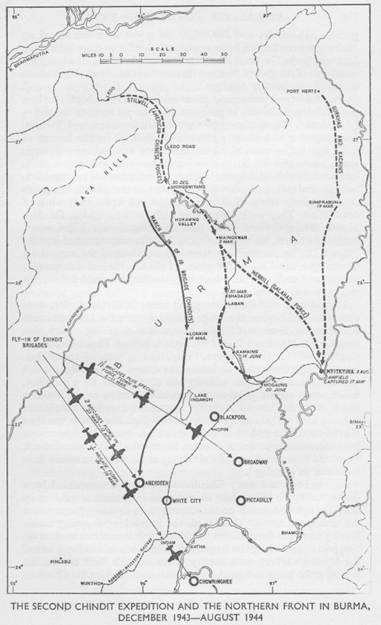
Fig 5:
Operation Thursday Air Launch Map
Wingate had forbidden continuous
reconnaissance of the landing sites to avoid compromising the security of the
operation, but Cochran ordered a last-minute reconnaissance
flight which showed "Piccadilly" to be completely obstructed with
logs. There was confusion that the operation had been betrayed, and that the
Japanese would have set up ambushes on the other two landing sites. Slim still ordered
that the operation was to go ahead. Wingate then ordered that 77th Brigade
would fly into "Chowringhee" (new landing site). Both Cochran and
Calvert objected, as "Chowringhee" was on the wrong side of the
Irrawaddy and Cochran's pilots were not familiar with the layout. Eventually,
"Broadway" was selected instead.
Despite
the last-minute drama, the operation was finally flagged off half an hour after
the planned time at 18:12. Each C-47 Dakota towed two gliders – all were
overloaded to at least 4500 pounds, bouncing and swaying all the way down the
airstrip, headed for the Chin Hills in the darkened sky. The original plan
called for 40 gliders to go to both Piccadilly and Broadway but finally all 80
would go to Broadway starting the airborne stage of ‘Operation Thursday’.
The mission was no longer in the hands of Wingate and his staff; it rested with
the pilots of the 1st Air Commando Group. In all, 35 gliders crash landed
on Broadway that night. Fortunately, the Japanese were unaware of the landings.
1st Air Commando Group of USAAF

Fig 6: Cover sent from US
APO 690 Ondal, India to USA on 11th Feb 1945 with Passed by US Army
Examiner 13676 handstamp. It was sent by 6th Fighter Squadron of 1st
Air Commando Group.
To
comply with Roosevelt's proposed air support for British long range
penetration operations in Burma (agreed during Quebec conference),
the United States Army Air Forces (USAAAF) created the 5318th Air
Unit to support the Chindits. In March 1944, they were designated the 1st
Air Commando Group by USAAF Commander General Hap Arnold. Arnold chose Colonel John R.
Alison and Colonel Philip Cochran as co-commanders of the unit.
It provided fighter cover, bomb striking power, and air transport services for
the Chindits, fighting behind enemy lines in Burma. Operations
included airdrop and landing of troops, food, and
equipment; evacuation of casualties; and attacks against
enemy airfields and lines of communication.
Their
first joint operation with the Chindits—Operation Thursday—was the first
invasion of enemy territory solely by air and set the precedent for the glider
landings of Operation Overload associated with the Normandy
Landings on D-Day. They also used helicopters in combat for the first
time, executing the first combat medical evacuations. They pioneered the use of
air-to-ground rockets.
111th Indian Infantry Brigade (also known as “LEOPARD”)
Unaware
of Wingate given authority to have far more ambitious offensive for his second LRP
expedition (during Quebec conference), General Wavell (also the Viceroy of
India) ordered the formation of 111th
Indian Infantry Brigade, along the lines of the 77th Indian Infantry
Brigade at the same time when Wingate was on the way to India. Wavell intended
that the two brigades would operate in tandem with one engaged on operations
while the other trained and prepared for the next operation. However, once back
in India, Wingate was allowed to have six brigades to achieve the goal. He was known
to have a strong dislike for the Indian Army, its diverse troop formations, and
its British officers. He maintained that their training in long-range
penetration techniques would take longer and their maintenance by air would be
difficult due to the varied dietary requirements of different Gurkha and
Indian castes and religions, although he had little choice but
to accept 111th Brigade.
111th
Indian Infantry Brigade was due to flown into Piccadilly on 5/6th
March 1944, but as that landing site was unusable, so it flew into “Chowringhee”
and “Broadway” instead. This left the brigade dispersed and ineffective until
it was reunited at “White City”. The goal for 111th Brigade was to move north and build a new stronghold, codenamed
‘Blackpool’ which would block the railway and main road
south of Mogaung. Blackpool was
close to the Japanese northern front and was immediately attacked by Japanese 53rd Division with heavy artillery
support. Even though a heavy attack against Blackpool was repulsed on
17th May, a second attack on 24th May allowed Japanese to
capture vital positions. Because the monsoon had broken and heavy rain made
movement in the jungle very difficult, neither 77th Brigade nor 14th
Brigade could help 111th Brigade. Finally, it had to
abandon Blackpool on 25th May, because the men were
exhausted after 17 days of continual combat. They were finally evacuated from Mogaung in the May.
Indian FPO 143 was used by 111th
Infantry Brigade until March 1944 before they flew into Burma. The FPO didn’t
carry them. From May’1944 onwards same FPO was reallocated to 109 Infantry
Brigade (14th Infantry Division).

Fig 7: On Golden Jubilee of 3rd Btn, 4th Gurkha Rifles
which was part of 111th Indian Infantry Brigade, Indian Army Postal
Service issued APS cover commemorating their exploits in 1990. Part of it was also in Morris Force which harassed
Japanese forces in the mountain ranges.

Fig 8: On Platinum
Jubilee of 3rd Btn, 4th Gurkha Rifles which was part of
111th Indian Infantry Brigade, Indian Army Postal Service issued APS
cover commemorating their exploits in 2015. The postmark shows Chindits logo as
well.
16th Infantry Brigade of British 70th Division (also known as
“ENTERPRISE”)
When Wingate returned
to India from Quebec conference with authority to implement far more ambitious plans for the second
expedition, which required that the force be greatly expanded to a strength of
six brigades, he was offered British 70th Division. infantries were required, three brigades
(the 14th, 16th and 23rd) were
added to the Chindits by breaking up the experienced British 70th
Division, much against the wishes of General Slim and other
commanders, who wished to use the division in a conventional role.
British 70th Division was a very experienced unit
seen action in the Middle East and Africa. Following the Japanese occupation of Malaya, and the consequent
threat to India, British 70th Division was withdrawn from the Middle
East at the end of Feb 1942 and sent to India. 16th Brigade of
British 70th Division, was temporarily detached for service in
Ceylon, arriving there on 15th Mar 1942. On 1st Feb 1943,
the brigade moved to India to join 70th Division. British FPO 40
accompanied 16th Brigade to Ceylon and Ceylonese stamps were used
while they operated there.

Fig 9: Cover sent from Ceylon to England using British FPO 40
in March 1942 (after they just arrived from Middle East) with Passed By Censor
90 handstamp.
The
plan for 16th Brigade was different as they were supposed to march
to its operational area from Ledo while 77th and 111th
Brigades were getting airlifted later. The
16th Brigade began its 350-mile (565-km) overland advance on 5th
February 1944 starting ‘Operation Thursday’ officially, avoiding the Japanese by crossing extremely difficult terrain.
It
took them close to 4 weeks (5th March 1944) to reach Chindwin River
crossing point. It was at the same time (6th March 1944) when
Japanese launched Operation ‘U-Go’, an invasion of eastern India. It
would take them another tough two weeks march south to reach their first objective,
a stronghold named “Aberdeen” (20th March 1944). It existed only on
paper and in the mind.
Wingate
intended that “Aberdeen” should rise from the ground on the labor and toil of
16th Brigade after their long march. From there they moved towards
Indaw. He hoped that the three brigades could then co-operate in the capture of
the communications nexus at Indaw, together with its airfield, so that a
division could be flown in to hold the area as a base for the Chindit columns
roving the Japanese rear areas and wreaking havoc. Though, 16th
Brigade failed to occupy Indaw and were withdrawn to India by May 1944.
14th Infantry Brigade of British 70th Division (also known as
“JAVELIN”)
Initially,
14th Brigade was supposed to be held in reserve along with 23rd
Brigade and 3rd West African Brigade. But, when Japanese threat at
Imphal and Kohima started developing, General Slim thought of diverting 14th
Brigade just like he did with 23rd Brigade to help Indian XXXIII
Corps. There were tense moments for Wingate as he was furious losing out
another of his brigade. Finally, Slim let Wingate keep 14th Brigade for Burma
offensive.
The
14th Infantry Brigade was airlifted to ‘Aberdeen’ on 23/24 March
1944 (same time when Wingate died in plane crash). While 16th
Brigade thought 14th Brigade would help it capture ‘Indaw’ which was
south to Aberdeen, 14th Brigade instead moved north towards ‘Blackpool’
and was involved in heavy fighting in the area with the Japanese. It helped 111th
Brigade capture Blackpool in May before eventually it was withdrawn to India in
August 1944.

Fig 10: Cover sent within India using British FPO 199 on 23rd
August 1944 (after 14th Infantry Brigade was withdrawn to India)
with Field Censor 35 and Unit Censor S 471 handstamp.
As
per [4], BFPO 199 was used
by 14th Brigade. It states that as a Special Forces P.O. it was used
from Dec’43-May’44 period. Though, there is some conflicting information on it.
Because, as per same catalogue it also states BFPO 37 was allotted to 14th
Brigade. While, as per [2] [Ch. 22 The Assam
Front, Page 247], it says BFPO 199 was allotted to 23rd Brigade. So,
it can’t be ascertained if BFPO 199 was used by 14th Brigade even
though it was used by one of the units of Special Forces. For now, I am
sticking to Proud where it shows 14th Brigade against BFPO 199.
23rd Infantry Brigade of British 70th
Division
It never joined the Chindits in the
field, was instead sent to support XXXIII Indian Corps to quell Japanese
attackers (Operation “U-Go” on 6th March 1944) in the Dimapur and Kohima
area. But their training as LRP came handy and in fact it was one of the
reasons why Japanese 31st division had to retreat when they ran out
of supply during the siege of Kohima.
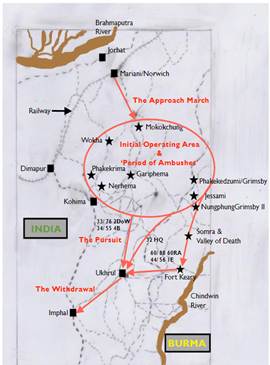
Fig 11: Above diagram shows 23rd Infantry Brigade
action against Japanese 31st division from April-July 1944
Japanese
31st Division had begun the operation with only three weeks supply
of food. Once these supplies were exhausted, the Japanese had to exist on
meagre captured stocks and what they could forage in increasingly hostile Naga
villages. The British 23rd Infantry Brigade, which had been
operating behind the Japanese division, cut the Japanese supply lines and
prevented them foraging in the Naga Hills to the east of Kohima. Lack of food
supply from Japanese Fifteenth Army HQ finally caused Japanese 31st
division to withdraw.
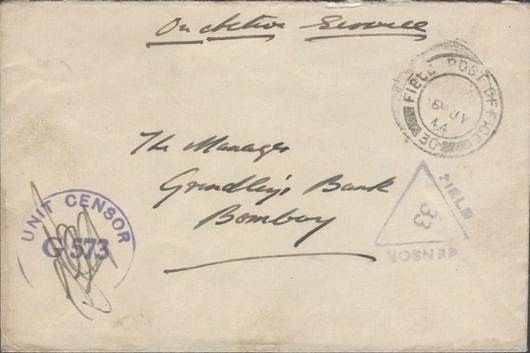
Fig 12: Cover sent to Bombay, India using British FPO 30 on 5th July 1944 (just
after Battle of Kohima was over by 22nd June 1944 and 23rd
Infantry Brigade was on pursuit of retreating Japanese forces towards Ukhrul
and Imphal until end of July) with Field Censor 33 and Unit Censor G 573
handstamp.
As per [4], British FPO 30
was used by 23rd Infantry Brigade in India. While [2] [Ch. 22 The Assam
Front, Page 247], says BFPO 199 was allotted to 23rd Brigade though
it doesn’t provide any further information on it. Similarly, since [1] also doesn’t show
BFPO 199 usage by 23rd Brigade so I am assuming Proud is correct to
state BFPO 30 usage for 23rd Infantry Brigade.
3rd West African Brigade of 81st West
African Division (also known as “THUNDER”)
The 3rd
(West African) Brigade was to be used as garrison troops for the strongholds.
One battalion was flown into Broadway and made its way on foot to Aberdeen. The
other two battalions were flown directly into Aberdeen on 23rd March
1944. The brigade returned to India by August 1944. The brigade was
disbanded on 30th November 1944. It then reformed with same units in
India on 1st March 1945 coming under command of 81st West
Africa Division on 20th March 1945.
All
West African Units in Burma (during Chindits operation and afterwards as part
of larger Burma campaign) used British FPOs. As per [1]British FPO 670, 696-699 were used by 81st
West African Division including their time (Dec 1943 - March 1945) in Burma so
perhaps one of those FPOs were used by 3rd West African Brigade as
well. I will allow experts to weigh in and share their thoughts.

Fig 13: “On Active Service” cover sent with in India using
British FPO 698 by 81st West African Division along with Unit Censor
G 139 handstamp in March 1945. This is just an example of 81st West
African Division usage in absence of any definitive cover usage by 3rd
West African Brigade.
Other units
Finally,
there were Morris Force which harassed Japanese forces in the mountain ridges
skirting the Bhamo-Myitkyina Road and then there was DAH Force a small 74 men
team which had Kachins of 2nd Burma Rifles as well Chinese from Hong
Kong volunteers. DAH was a diversified team with British, Americans, Indians,
Kachins and Chinese in it. Besides them there were other units supporting
Chindits operations, but I am skipping them to concentrate only on the main ones.
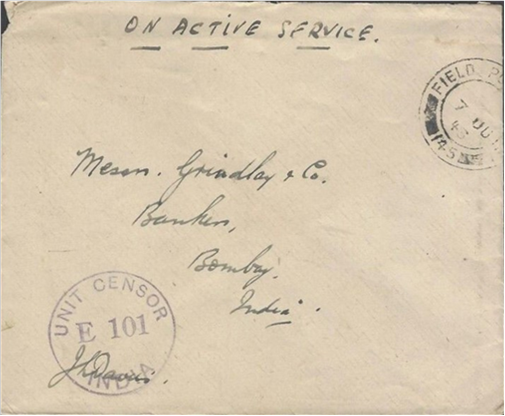
Fig 14: Cover sent
to Bombay, India using British FPO 145 on 7th Jun 1943 (before the
second Chindits offensive) with Unit Censor E 101 handstamp.
As
per Proud and Virk, in general BFPO
30/37/40/145/199 were used by British 70th Division Special Forces
(meant for LRP) at different point in time. So, I am showing usage of BFPO 145
though there is no clear information in either [1] or [3] which British Infantry Brigade was using it.

Fig 15: On Silver Jubilee of 4th
Btn, 9th Gurkha Rifles which was part of Morris Force, Indian Army
Postal Service issued APS cover commemorating their exploits in 1987. Since the
battalion was re-raised in 1961 that’s why it says Silver jubilee although 9th
Gorkha Rifles regiment was originally formed by the British in the 1817. On
this occasion a special postmark showing Chindits symbol was also issued.

Fig 16: On Diamond Jubilee of
4th Btn, 9th Gurkha Rifles, Indian Army Postal Service
issued APS cover commemorating their exploits in 2021. Note that it shows 1961
as starting year as stated earlier.
Conclusion
While
Wingate and allies were unaware of timing of Japanese plans of invasion of India,
at the same time, Operation Thursday timing just coincided with it and did
cause damage to Japanese offensive. As shared earlier in the introduction
section while historians have different views on overall effect of the special
operations and seen in various Brigade brief history above, the operations may
not have achieved its original goal as it had to face strong Japanese Army, it did
have huge psychological effect on the Japanese Army as they created havoc by
disrupting food supply and communication lines. Chindits used to appear all
sudden from dense forest of Burma, attack Japanese columns and used to hide
again in the forest well supported by Nisei and Kachins. They created fear in
Japanese minds.
Acknowledgement
Some
of the background information including maps have been sourced from Wikipedia. Various FPO usage has been referred from British and
Indian Army Postal Services Catalogues/Books by Proud and Virk as mentioned
below.
References:
[1]
History
of Indian Army Postal Services – D. S. Virk
[2]
Indian Army Post
Offices in the Second World War – D. S. Virk
[3]
History of the Indian Army Postal Service
Volume III - Proud
[4]
British Army Postal Service Vol III –
Proud
I
also expect there may be errors on selecting or describing postal history of
the FPO covers. Please feel free to correct me and share any relevant FPO
covers that one may have (either for exhibit or sale) directly at my email-id jbareria@gmail.com. And do read the second part of the article showcasing
American Special Operations which were launched at the same time in my earlier post.


